
Data & Analytics
Online
beginner Level
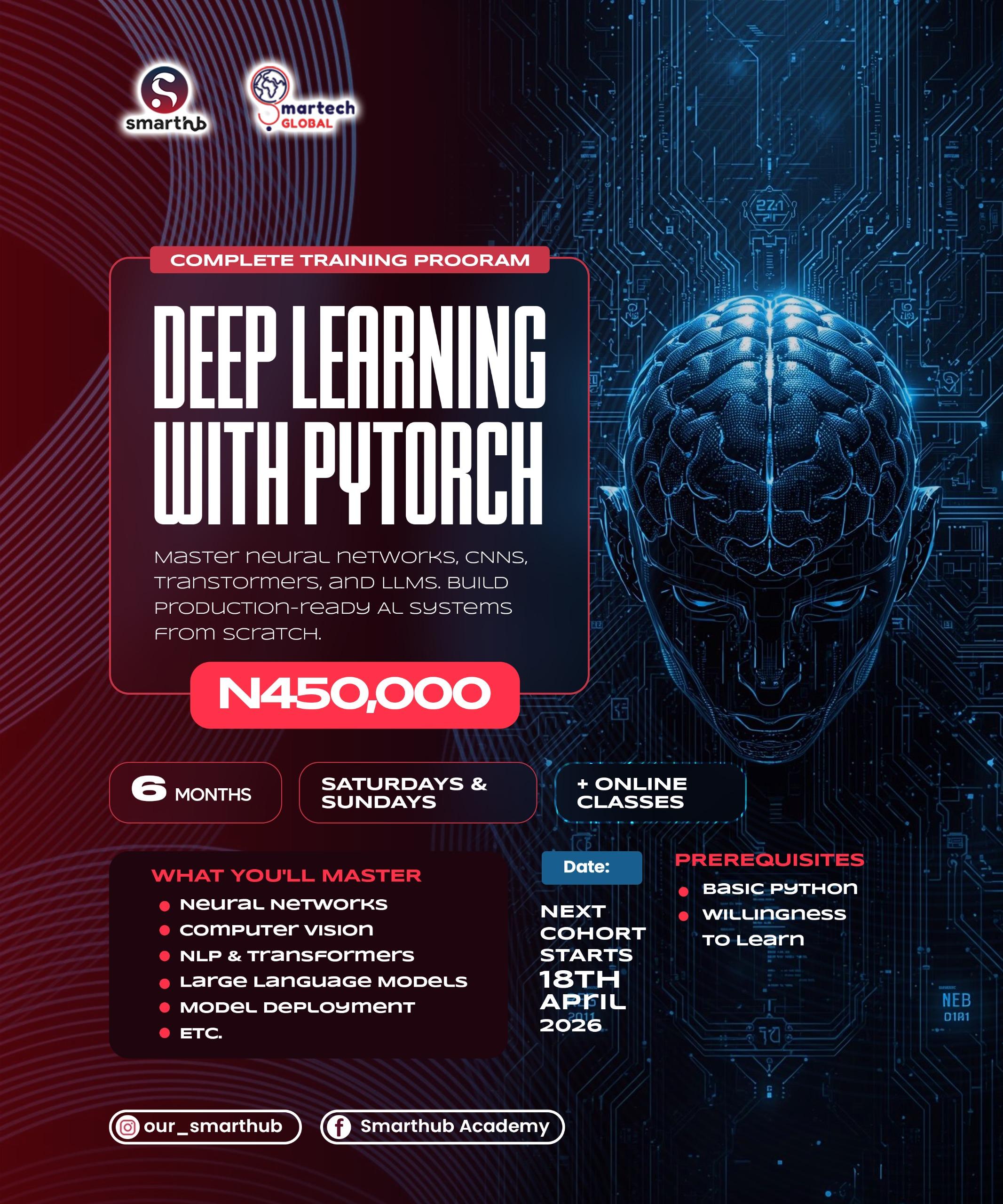
Deep Learning with Pytorch
Starts 12 October 2026•6 months
Overview
About this programme
This comprehensive program takes you from Classical Machine Learning through to cutting-edge Large Language Models. Starting with traditional ML (scikit-learn), you'll understand why deep learning exists before diving into neural networks with PyTorch. The curriculum spans 9 phases: Classical ML Foundations, Math & PyTorch Basics, Core Deep Learning Mechanics, PyTorch Abstractions, Core Architectures (CNNs, RNNs, Transformers), Practical Deployment, NLP, Generative Networks (VAEs, GANs, Diffusion), and LLMs.
By completion, you'll build and train ML models from scratch, implement computer vision and NLP solutions, fine-tune Large Language Models using LoRA and RAG, and deploy models to production.
Ideal for software developers, data analysts, and Python programmers entering AI. Weekend classes (online) suit working professionals. Prerequisites: Basic Python and high school math.
Curriculum
Programme structure
9 modules
- This foundational module covers traditional machine learning before diving into deep learning. You'll master the complete ML workflow using scikit-learn: data preparation, model building, evaluation, and improvement. Topics include supervised vs unsupervised learning, regression models (Linear, Polynomial), classification models (Logistic Regression, Decision Trees, Random Forests, SVM), clustering (K-Means), and essential evaluation metrics (Accuracy, Precision, Recall, F1, ROC-AUC). By understanding classical ML first, you'll appreciate why and when deep learning is needed.
- Understand the ML landscape: supervised vs unsupervised learning, regression vs classification
- Prepare data properly: train/validation/test splits, cross-validation, feature scaling
- Build and train regression models: Linear Regression, Polynomial Regression, Ridge, Lasso
- Build and train classification models: Logistic Regression, Decision Trees, Random Forests, SVM
- Evaluate models using appropriate metrics: Accuracy, Precision, Recall, F1-Score, ROC-AUC
- Diagnose and fix overfitting/underfitting using regularization and hyperparameter tuning
- Master the scikit-learn workflow: pipelines, preprocessing, and model persistence
You'll build: a supervised model with proper train/validation/test splits and cross-validation
Module 1: Classical Machine Learning
This foundational module covers traditional machine learning before diving into deep learning. You'll master the complete ML workflow using scikit-learn: data preparation, model building, evaluation, and improvement. Topics include supervised vs unsupervised learning, regression models (Linear, Polynomial), classification models (Logistic Regression, Decision Trees, Random Forests, SVM), clustering (K-Means), and essential evaluation metrics (Accuracy, Precision, Recall, F1, ROC-AUC). By understanding classical ML first, you'll appreciate why and when deep learning is needed.
- Understand the ML landscape: supervised vs unsupervised learning, regression vs classification
- Prepare data properly: train/validation/test splits, cross-validation, feature scaling
- Build and train regression models: Linear Regression, Polynomial Regression, Ridge, Lasso
- Build and train classification models: Logistic Regression, Decision Trees, Random Forests, SVM
- Evaluate models using appropriate metrics: Accuracy, Precision, Recall, F1-Score, ROC-AUC
- Diagnose and fix overfitting/underfitting using regularization and hyperparameter tuning
- Master the scikit-learn workflow: pipelines, preprocessing, and model persistence
You'll build: a supervised model with proper train/validation/test splits and cross-validation