Deep Learning with Pytorch

Home

Courses

Data & Analytics

Deep Learning with Pytorch

6 months duration
9 modules
Updated Feb 20, 2026
Data & Analytics
Deep Learning with Pytorch
Recently Updated

Course Overview

Get to know what this course is all about and what you'll learn

Course Description

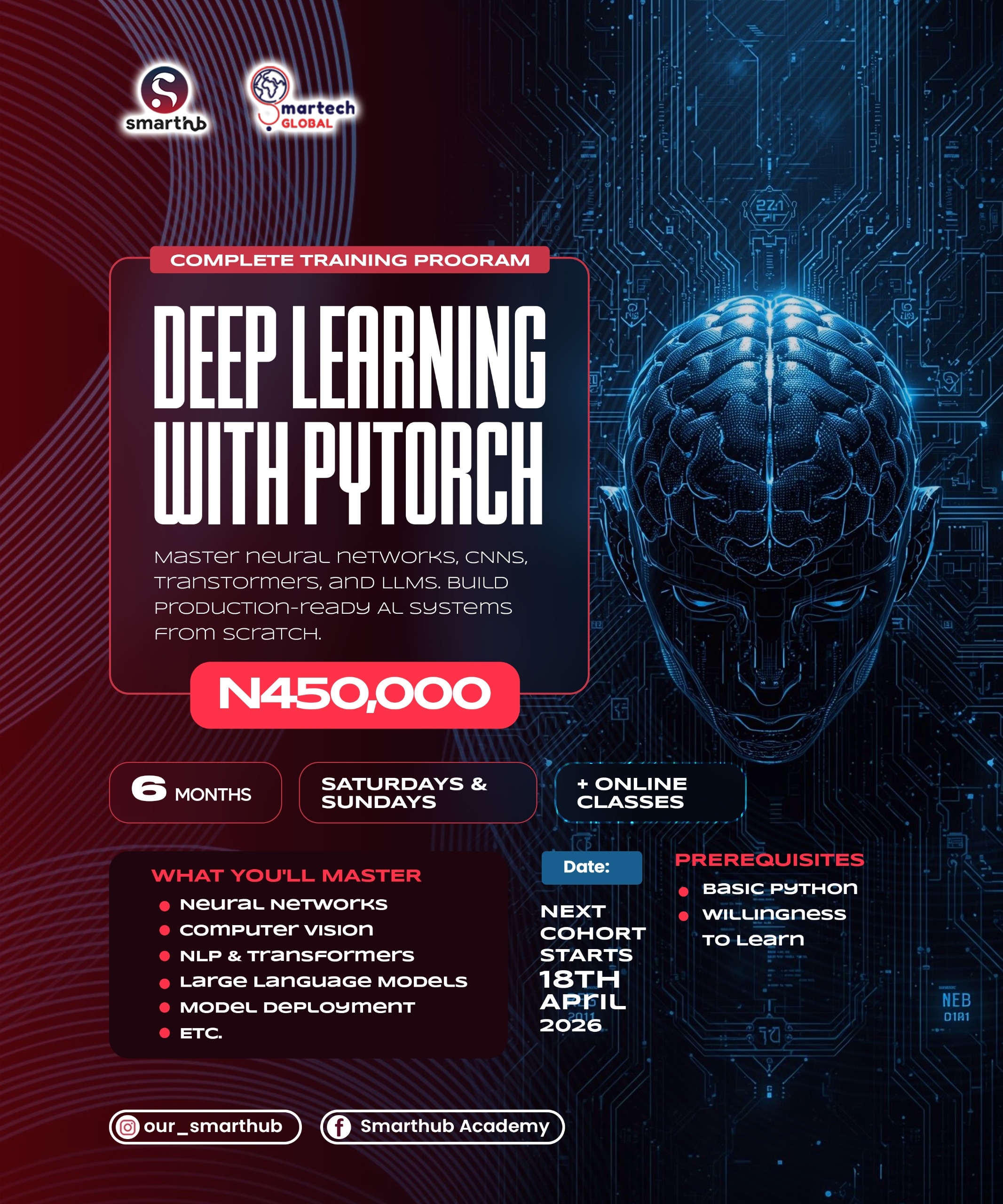
Master neural networks, CNNs, Transformers, and Large Language Models from scratch. A comprehensive 6 months program that takes you from Python basics to building production-ready AI systems with PyTorch.

What You'll Learn

This comprehensive program takes you from Classical Machine Learning through to cutting-edge Large Language Models. Starting with traditional ML (scikit-learn), you'll understand why deep learning exists before diving into neural networks with PyTorch. The curriculum spans 9 phases: Classical ML Foundations, Math & PyTorch Basics, Core Deep Learning Mechanics, PyTorch Abstractions, Core Architectures (CNNs, RNNs, Transformers), Practical Deployment, NLP, Generative Networks (VAEs, GANs, Diffusion), and LLMs.

By completion, you'll build and train ML models from scratch, implement computer vision and NLP solutions, fine-tune Large Language Models using LoRA and RAG, and deploy models to production.

Ideal for software developers, data analysts, and Python programmers entering AI. Weekend classes (online) suit working professionals. Prerequisites: Basic Python and high school math.

Course Curriculum

9 modules • Learn at your own pace • Hands-on experience

Course Modules

This foundational module covers traditional machine learning before diving into deep learning. You'll master the complete ML workflow using scikit-learn: data preparation, model building, evaluation, and improvement. Topics include supervised vs unsupervised learning, regression models (Linear, Polynomial), classification models (Logistic Regression, Decision Trees, Random Forests, SVM), clustering (K-Means), and essential evaluation metrics (Accuracy, Precision, Recall, F1, ROC-AUC). By understanding classical ML first, you'll appreciate why and when deep learning is needed.

What you'll learn

  • Understand the ML landscape: supervised vs unsupervised learning, regression vs classification
  • Prepare data properly: train/validation/test splits, cross-validation, feature scaling
  • Build and train regression models: Linear Regression, Polynomial Regression, Ridge, Lasso
  • Build and train classification models: Logistic Regression, Decision Trees, Random Forests, SVM
  • Evaluate models using appropriate metrics: Accuracy, Precision, Recall, F1-Score, ROC-AUC
  • Diagnose and fix overfitting/underfitting using regularization and hyperparameter tuning
  • Master the scikit-learn workflow: pipelines, preprocessing, and model persistence
Build the mathematical intuition and PyTorch skills essential for deep learning.

This module covers linear algebra (vectors, matrices, tensors), calculus (derivatives, chain rule, gradients), probability distributions, and comprehensive PyTorch tensor operations including GPU computing.

You'll also master automatic differentiation with PyTorch's autograd system.

What you'll learn

  • Perform vector and matrix operations essential for neural networks
  • Master PyTorch tensor creation, manipulation, and GPU computing
  • Understand and use automatic differentiation with autograd
  • Build computation graphs and control gradient flow
Build neural networks from the ground up before using any framework abstractions.

This module covers artificial neurons, activation functions, forward propagation, the backpropagation algorithm, gradient flow challenges (vanishing/exploding gradients), weight initialization, and complete training loop implementation with loss functions, optimizers, and learning rate scheduling.

What you'll learn

  • Build neural networks from scratch without using nn.Module
  • Implement and understand backpropagation using the chain rule
  • Diagnose and solve vanishing/exploding gradient problems
  • Master the complete training loop with proper loss functions and optimizers
Master PyTorch's core abstractions for building neural networks efficiently.

This module covers nn.Module internals, custom module creation, parameters vs buffers, module composition patterns (Sequential, ModuleList, ModuleDict), hooks for debugging, and comprehensive coverage of optimizers and regularization techniques including Dropout and Batch Normalization.

What you'll learn

  • Build custom nn.Module classes with proper structure
  • Compose modules using Sequential, ModuleList, and ModuleDict
  • Apply regularization techniques to prevent overfitting
  • Use normalization layers effectively in different contexts
Master the fundamental deep learning architectures that power modern AI.

This module covers Convolutional Neural Networks for computer vision, Recurrent Neural Networks for sequential data, Attention Mechanisms that revolutionized the field, and Transformers—the architecture behind GPT and BERT.

What you'll learn

  • Build CNN architectures including ResNet with skip connections
  • Implement RNNs, LSTMs, and GRUs for sequence processing
  • Master attention mechanisms and multi-head attention
  • Build complete Transformer encoder-decoder from scratch
Bridge the gap from experiments to production systems.

This module covers transfer learning strategies for leveraging pre-trained models, fine-tuning techniques, and comprehensive model deployment including optimization, export formats, API development, and containerization.

What you'll learn

  • Apply transfer learning and fine-tuning to real problems
  • Optimize models for production deployment
  • Build REST APIs for model inference
  • Deploy models using Docker containers
Master natural language processing with deep learning.

This module covers text representation (tokenization, embeddings), sequence-to-sequence models for translation and summarization, and modern NLP architectures including BERT and GPT with hands-on use of the Hugging Face ecosystem.

What you'll learn

  • Implement tokenization and use pre-trained embeddings
  • Build sequence-to-sequence models with attention
  • Understand BERT and GPT architectures
  • Fine-tune pre-trained models using Hugging Face
Create AI that generates new content.

This module covers autoencoders and VAEs for learning latent representations, GANs for adversarial generation, and diffusion models—the technology behind Stable Diffusion and modern image generation.

What you'll learn

  • Build VAEs and understand latent space representations
  • Implement GAN training and diagnose common issues
  • Understand diffusion models and denoising training
  • Generate images using learned generative models
Work with state-of-the-art language models.

This module covers LLM architecture internals (GPT, LLaMA), efficient fine-tuning techniques (LoRA, QLoRA), Retrieval-Augmented Generation for production applications, and a comprehensive capstone project to demonstrate your skills.

What you'll learn

  • Understand GPT and LLaMA architectures in detail
  • Fine-tune LLMs efficiently using LoRA and QLoRA
  • Build RAG pipelines for production applications
  • Complete an end-to-end AI project from design to deployment