
1 August 20260 speakers
Beyond the Click:Day-1
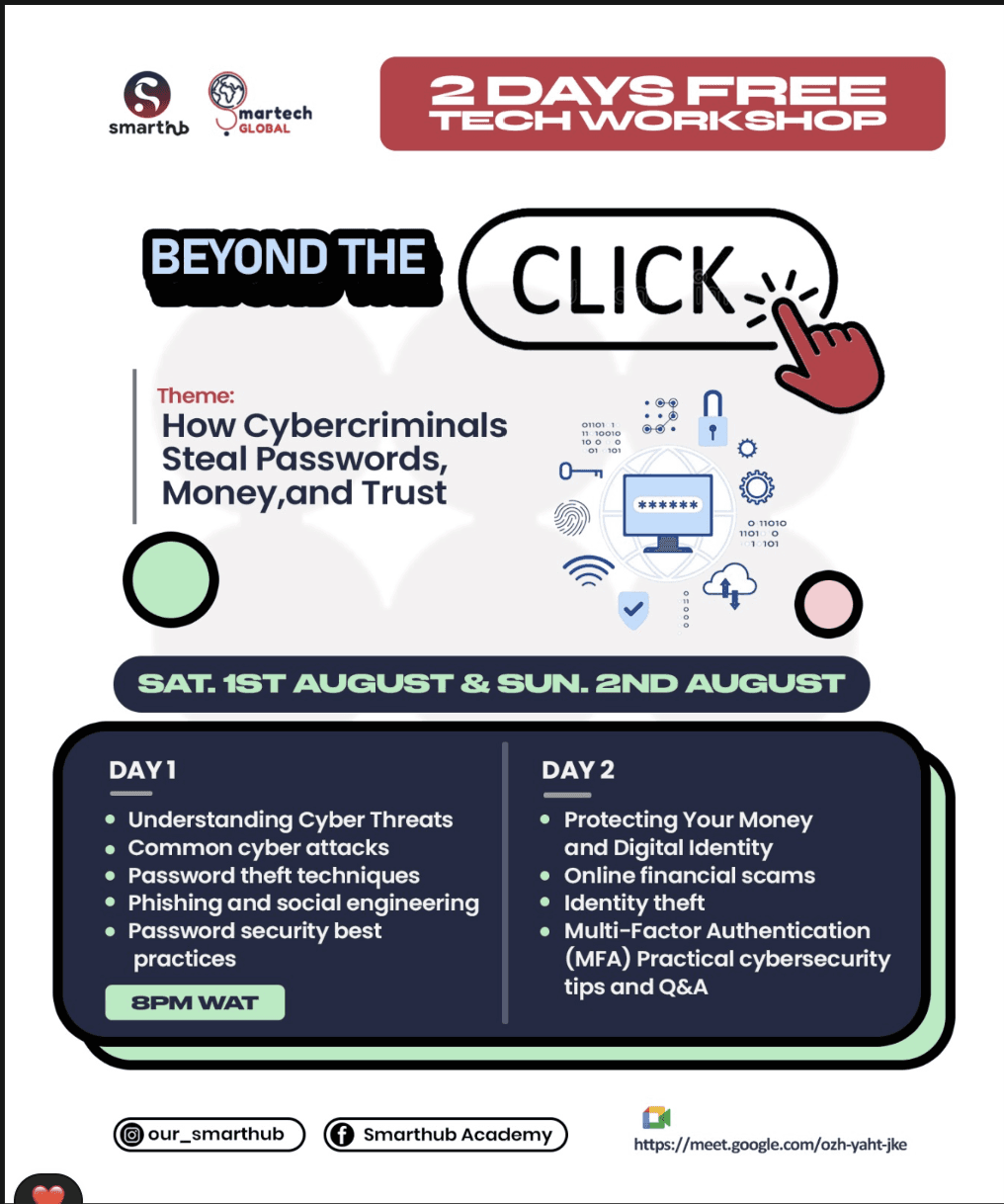
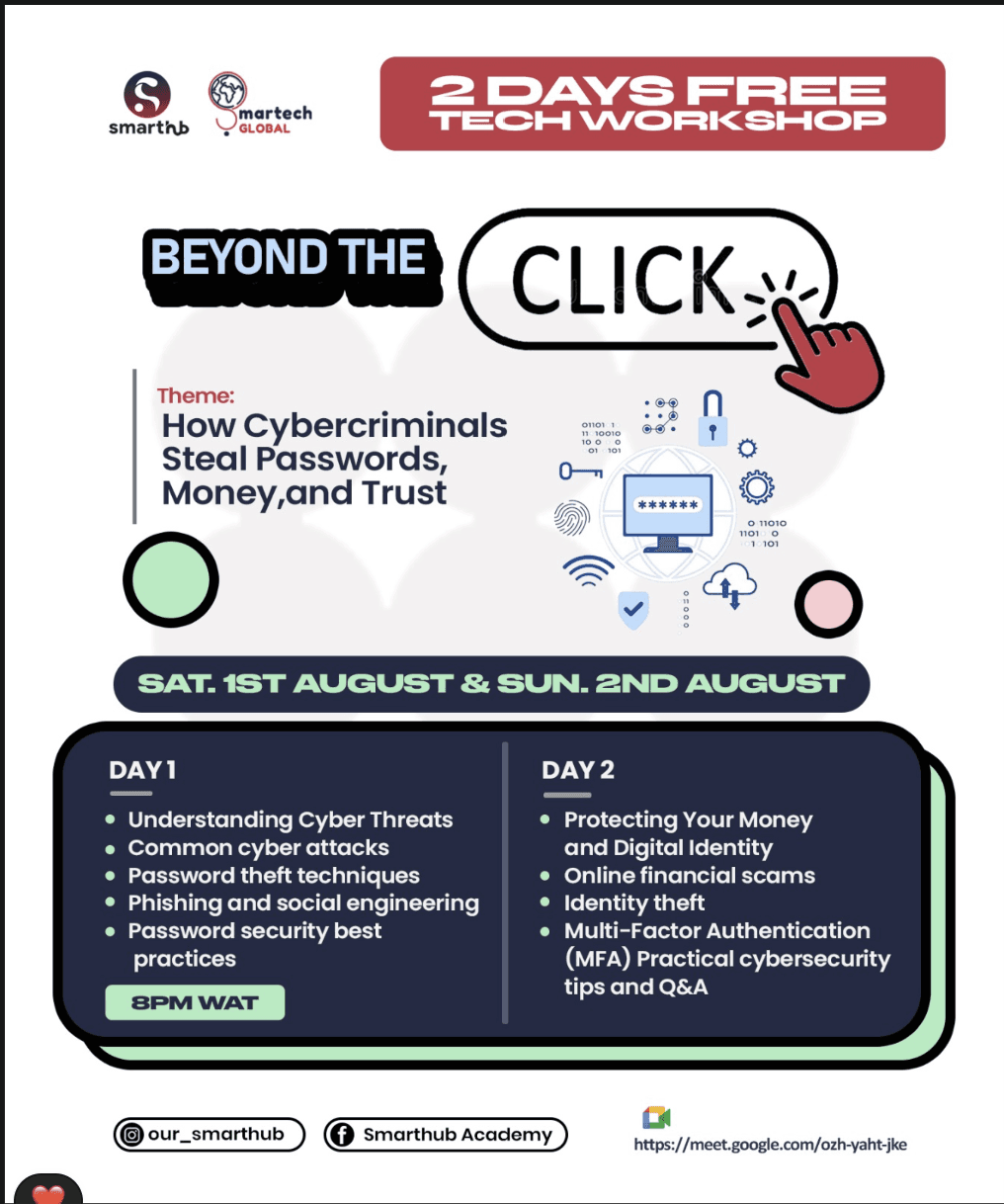
This was Day 1 of a two-day Smarthub Academy cybersecurity webinar titled "Beyond the Click," held on August 1, 2026, focused on how cyber criminals steal passwords, money, and trust. Justina Augustus moderated the session (with coaching from Edison Sime), opening with announcements about current cohorts, the scholarship scheme, and a new course starting October 12th. The main content was delivered by Emmanuel Uwa, a security engineer at Matup Academy, who walked participants through the landscape of modern cyber threats. He explained that cyber crime today operates like an organized business rather than the work of lone hackers, then covered the major attack methods: phishing (fake messages impersonating trusted entities), malware, vishing (phone-based scams), fake copycat websites, data breaches (using the 2013 Yahoo breach of 3 billion accounts as a case study), and social engineering — which he emphasized as the most dangerous tactic because it manipulates human emotions rather than attacking systems directly. He illustrated these with real examples, including the Colonial Pipeline ransomware attack, a pizza-themed phishing test his team ran on a client company, and his own near-miss with a fake scholarship scam on Instagram. The session closed with practical defenses: avoiding predictable and reused passwords, being wary of open public Wi-Fi, spotting phishing red flags like false urgency and requests for sensitive details (PINs, BVN, NIN), carefully checking URLs for subtle misspellings, understanding that the HTTPS padlock doesn't guarantee legitimacy, and adopting password managers and multi-factor authentication as the primary lines of defense. Day 2 will feature a live simulated phishing attack in a safe lab environment, and attendees were encouraged to enable MFA, disable auto-connect to open Wi-Fi, join the community group chat, and invite friends to the next session.